
Introduction
Few works of art have captured the imagination of humanity quite like The Creation of Adam by Michelangelo Buonarroti. Painted around 1511 on the ceiling of the Sistine Chapel in Vatican City, this single fresco has transcended its religious origins to become one of the most recognizable and discussed images in history. Whether you are an art enthusiast, a student of history, or simply someone who has seen the iconic near-touching hands reproduced on posters, walls, and digital screens around the world, you have felt the power of this masterpiece.
The Creation of Adam represents far more than the moment when God gives life to the first man. It embodies the Renaissance ideal of humanity’s divine potential, the celebration of the human body, and the eternal question of what it means to be created in the image of God. In this article, we’ll explore the origins, artistic techniques, symbolism, interpretations, and enduring legacy of this monumental work of art.
Historical Background: A Commission That Changed Art History
The Sistine Chapel ceiling, which contains The Creation of Adam, was commissioned by Pope Julius II in 1508. Michelangelo, already famous as a sculptor for his David and Pietà, initially resisted the project. He considered himself a sculptor, not a painter. However, the Pope insisted, and Michelangelo reluctantly accepted.
Over the next four years, Michelangelo would transform the chapel’s ceiling into a vast visual narrative drawn from the Book of Genesis. The frescoes depict the creation of the world, the fall of humankind, and the story of Noah, all culminating in the powerful and intimate scene of God creating Adam.
Painted on wet plaster high above the ground, Michelangelo’s work was physically demanding and mentally exhausting. Yet, the results were revolutionary. He introduced a monumental style that combined sculptural anatomy with divine grandeur, blending spirituality and physical perfection in a way that had never been seen before.
The Creation of Adam, located roughly at the center of the ceiling, became the symbolic heart of the entire project.
Composition and Visual Impact
At first glance, the composition appears simple: two figures, God and Adam, reach toward one another, their fingers separated by the smallest of gaps. Yet within that space lies the essence of creation, the divine spark, and the very mystery of life.
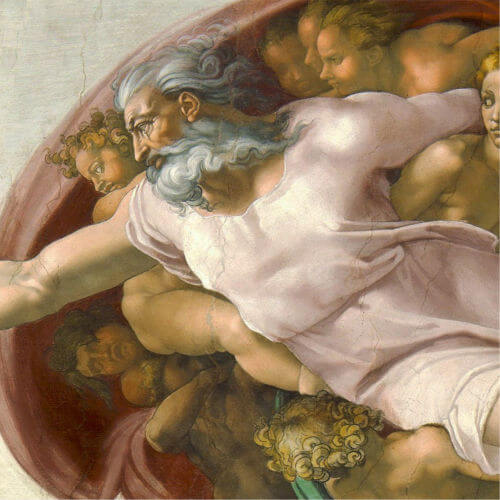
Michelangelo’s genius lies in how he uses the human form to communicate spiritual meaning. Adam reclines on a barren landscape, his body relaxed but not lifeless. His gaze is directed toward God, and his arm extends languidly toward the approaching Creator. God, on the other hand, is dynamic, wrapped in a swirling cloak supported by angels, His arm outstretched with deliberate power.
Between their fingertips, Michelangelo leaves a breath of distance, a visual tension that evokes expectation. That tiny space has become one of the most studied and imitated gestures in the history of art. It suggests not only the transfer of life but the infinite potential of human connection with the divine.
The colors are warm yet ethereal. Adam’s body is rendered in soft flesh tones that emphasize his humanity, while God is surrounded by vibrant reds and greens that separate the spiritual from the earthly. The light seems to emanate from both figures, uniting them through shared vitality.
Symbolism and Meaning
1. The Divine Spark
The most direct interpretation of The Creation of Adam is that it captures the moment God imparts life to the first human being. The near-touch of their hands represents the transfer of the divine spark—the breath of life that animates humanity. This spark is not just biological but spiritual and intellectual. It symbolizes the human capacity for thought, creativity, and love, qualities that mirror divine attributes.
2. The Image of God
Adam’s posture mirrors God’s, suggesting that man is created “in the image and likeness of God,” as described in Genesis. Michelangelo visualizes this theological idea with astonishing clarity: Adam’s body, though relaxed, mirrors God’s strength and majesty. The resemblance underscores the Renaissance belief that humanity possesses inherent dignity and the potential for greatness.
3. The Space Between
The most famous part of the painting is arguably the tiny gap between God’s and Adam’s fingers. That separation is not accidental. It represents the eternal distance between Creator and creation. Humanity can strive toward God but can never fully become divine. The energy and anticipation in that gap are what give the fresco its emotional and spiritual power.
4. The Hidden Anatomical Symbolism
Modern scholars have proposed that the shape of God’s cloak and the arrangement of angels around Him form a precise outline of the human brain. If true, Michelangelo, who studied anatomy extensively, might have been suggesting that God’s greatest gift to humanity is not just life but intellect and consciousness. Some interpretations even see the red drapery as a womb, positioning God as both father and giver of life.
5. The Renaissance Spirit
The painting also reflects Renaissance humanism, a movement that emphasized human potential and reason. While deeply religious, the image celebrates the human form with a naturalism and idealism that affirm human dignity. Adam’s muscular body reflects Michelangelo’s background as a sculptor and his fascination with anatomy. The human body, in this context, becomes a temple of divine design.
The Artistic Technique Behind the Masterpiece
Painting The Creation of Adam required extraordinary technical skill. Michelangelo used the fresco technique, in which pigments are applied to wet plaster so that the paint becomes part of the wall itself. Once the plaster dries, the color becomes permanent.
The challenge of painting on the ceiling was immense. Michelangelo designed his own scaffolding that allowed him to lie on his back and paint overhead. He often worked long hours in difficult conditions, sometimes painting entire sections before the plaster could dry.
His use of chiaroscuro (the contrast between light and dark) gave depth to the figures, while his mastery of anatomy ensured that every muscle, tendon, and limb appeared lifelike. Unlike earlier depictions of divine subjects that were stiff or symbolic, Michelangelo’s figures possess weight, movement, and realism.
Each brushstroke communicates both technical precision and emotional depth. The drapery surrounding God swirls with energy, suggesting movement and vitality, while Adam’s relaxed pose reflects a perfect harmony between repose and anticipation.
Placement Within the Sistine Chapel
The Creation of Adam is located on the central part of the Sistine Chapel ceiling. It sits among nine scenes from Genesis, including The Separation of Light from Darkness, The Creation of Eve, and The Fall of Man.
By positioning this fresco near the middle, Michelangelo ensured that it would serve as the spiritual centerpiece of the entire ceiling. Visitors entering the chapel are naturally drawn to it. Its scale, clarity, and emotional resonance make it the most memorable scene among the many biblical stories depicted overhead.
The surrounding panels, which show prophets, sibyls, and ancestors of Christ, create a theological narrative that connects humanity’s creation, fall, and eventual redemption. In that sense, The Creation of Adam serves as the beginning of the human story in Christian theology.
Interpretations Through the Ages
Since its completion, The Creation of Adam has inspired countless interpretations from theologians, historians, and scientists.
Theological Interpretations
From a religious perspective, the fresco represents God’s grace and the intimate relationship between Creator and creation. The nearly touching hands capture the moment before life is given, reinforcing the mystery of divine intervention and the gift of free will.
Philosophical and Humanist Readings
Renaissance humanists saw in the painting a declaration of humanity’s nobility. By portraying Adam as beautiful, strong, and intelligent, Michelangelo celebrated human potential. The image suggests that mankind is not a passive recipient of life but an active participant in the divine order.
Scientific and Anatomical Theories
Modern scholars have proposed scientific symbolism within the artwork. Some see the surrounding shape of God’s cloak as representing a human brain, symbolizing intellect and consciousness. Others believe it may represent a uterus, implying creation as birth. These theories, while speculative, reflect how the fresco continues to spark curiosity and dialogue centuries later.
Cultural and Artistic Influence
Beyond theology and philosophy, The Creation of Adam has become a visual shorthand for life, creativity, and inspiration. It has been reproduced in countless forms—from pop culture parodies and advertisements to fashion designs and digital art. Its universality lies in its simplicity: two hands reaching for connection.
Michelangelo’s Legacy
Michelangelo’s genius lies not just in his technical mastery but in his ability to unite body, mind, and spirit in a single image. The Creation of Adam embodies his vision of humanity as both earthly and divine. The painting marked a turning point in Western art, influencing generations of artists who sought to capture the complexity of human emotion and spiritual aspiration.
For Michelangelo, art was a means of devotion as well as expression. Though he often saw himself as unworthy of his subject matter, his work became a vessel through which others could glimpse divine beauty. The fresco stands as both a personal triumph and a universal symbol of faith and humanity.

Restoration and Preservation
Centuries of candle smoke, humidity, and pollution had darkened the Sistine Chapel ceiling, muting its colors. Between 1980 and 1994, the Vatican undertook an extensive restoration project. The results revealed Michelangelo’s original palette—vivid blues, greens, and pinks that had long been hidden beneath grime.
The restoration sparked debate among art historians. Some argued that the cleaning removed intentional shading, while others praised the project for revealing Michelangelo’s true brilliance. Regardless of opinion, the renewed vibrancy brought The Creation of Adam closer to how it appeared five hundred years ago.
Today, millions of visitors gaze upward each year, captivated by its color, form, and spirit.
Why The Creation of Adam Still Matters
In an age of digital art and modern abstraction, The Creation of Adam continues to resonate. Its enduring appeal lies in universal themes that transcend religion and time.
-
Connection: The near-touch between God and Adam reflects humanity’s eternal search for connection—spiritual, emotional, and personal.
-
Creation and Potential: The image celebrates the miracle of life and the potential within every human being to create, think, and feel.
-
Beauty and Faith: Michelangelo’s depiction of the divine as human-like bridges the gap between heaven and earth, inviting viewers to find divinity within themselves.
-
Artistic Excellence: Technically, the fresco remains a benchmark for artistic achievement, representing the height of Renaissance artistry.
In a world that often feels disconnected, this image reminds us of our shared origins and the power of a single touch.
Conclusion
The Creation of Adam is far more than a biblical illustration. It is a meditation on existence, consciousness, and the boundless relationship between humanity and the divine. Michelangelo transformed plaster and pigment into a timeless vision of life itself—a reminder that the human spirit, like Adam’s outstretched hand, forever reaches toward something greater.
From the grandeur of the Sistine Chapel to the screens of modern devices, the image continues to speak to us. It invites reflection on who we are, where we come from, and what connects us all. It is both ancient and modern, spiritual and human, sacred and profoundly universal.
Michelangelo’s masterpiece endures because it captures the essence of creation—not only of the first man but of art, of inspiration, and of the eternal dialogue between God and humanity. Every time we see those almost-touching hands, we are reminded that life itself is a gift, and reaching toward something higher is what makes us truly human.
